Companies use search engine optimization (SEO) and search engine marketing (SEM) to make their websites more visible online. When used correctly, these strategies can help businesses attract customers and increase website traffic. However, some companies try to get faster results by using tactics that manipulate search engines. These strategies may work temporarily, but they can also hurt a company’s reputation and search rankings.
A well-known example of unethical SEO involved J.C. Penney in 2011. An investigation found that thousands of unrelated websites linked back to J.C. Penney’s site. Many of these links used specific keywords connected to products the company sold, which helped J.C. Penney rank very highly in Google searches. Some of the websites providing these links had little or no connection to the products being promoted. After Google learned about the link scheme, it determined that the tactics violated its guidelines and took action against the website. J.C. Penney’s rankings dropped significantly for many of the search terms where it had previously appeared near the top (Fox, 2011).
The J.C. Penney case shows how unethical SEO can involve manipulating backlinks to improve search rankings. J.C. Penney said it was unaware of the links and later fired the SEO company it had been working with (Fox, 2011). Even though the company said it did not know about the strategy, the penalty still affected its website. This shows why businesses should pay attention to the SEO practices outside marketing companies use.
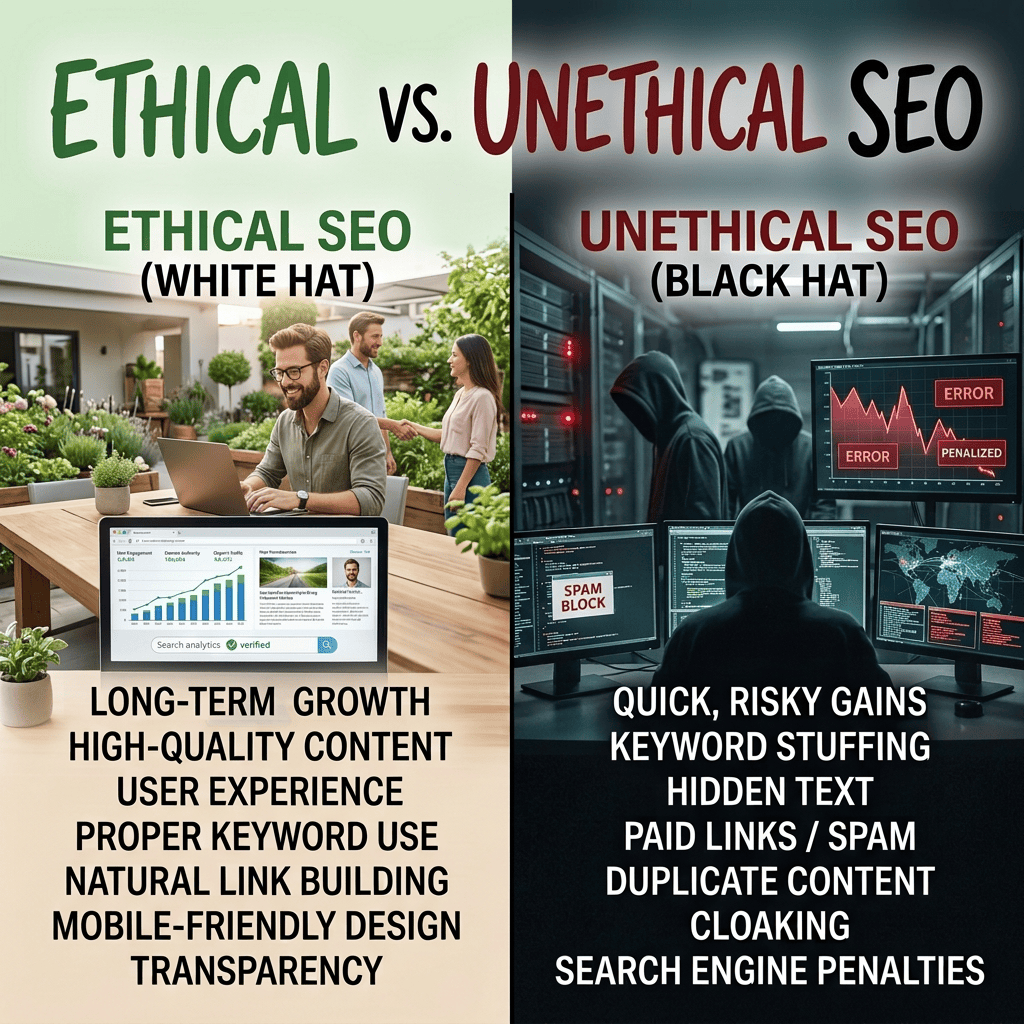
Several other examples of unethical SEO practices exist. According to Google Search Central, keyword stuffing is repeatedly using keywords or phrases unnaturally to manipulate search rankings. Other practices include buying links to improve rankings, hiding text or links from visitors, and creating large amounts of low-quality content mainly to influence search results (Google, n.d.). The Ethical SEO vs. Unethical SEO article also explains that unethical, or “black hat,” SEO takes shortcuts to improve rankings instead of providing a better user experience (Optimus Agency, n.d.).
Ethical SEO is different because it focuses on improving the website for the people actually using it. Ethical practices include creating useful, original content; using keywords naturally; improving website speed and mobile performance; using internal links appropriately; and earning backlinks from trustworthy websites. These strategies follow search engine guidelines instead of trying to find ways around them. Optimus Agency (n.d.) explains that ethical SEO generally takes more time, but it can create more sustainable results.
There are several benefits to using ethical SEO and SEM strategies. One major benefit is that a company can build trust with customers while protecting its online reputation. Ethical practices also reduce the risk of search engine penalties. Google explains that websites that violate its spam policies may rank lower or may not appear in search results at all (Google, n.d.). Losing search visibility can also mean losing potential customers who would normally find the business through Google.
Overall, the J.C. Penney example shows that taking shortcuts with SEO can create serious problems for a company. Even if unethical strategies produce quick results, those results may not last. Ethical SEO is a better long-term approach because it focuses on useful content, a positive user experience, and following search engine guidelines. Businesses that use ethical practices are more likely to build sustainable rankings and maintain customer trust.
References
Fox, V. (2011, February 12). New York Times exposes J.C. Penney link scheme that causes plummeting rankings in Google. Search Engine Land.
https://searchengineland.com/new-york-times-exposes-j-c-penney-link-scheme-that-causes-plummeting-rankings-in-google-64529
Google. (n.d.). Spam policies for Google web search. Google Search Central.
https://developers.google.com/search/docs/essentials/spam-policies
Optimus Agency. (n.d.). Ethical SEO vs. unethical SEO.
https://optimus01.co.za/ethical-seo-vs-unethical-seo/


Leave a Reply